Climate | Façades | Adaptation

Climate-Responsive Building Envelopes

The façade that wraps around the new 34-story tower creates a new but contextually-rooted beacon for the city.

The folding-stone pattern of the façade’s window clusters merges future-looking design with the indigenous culture and natural surroundings.

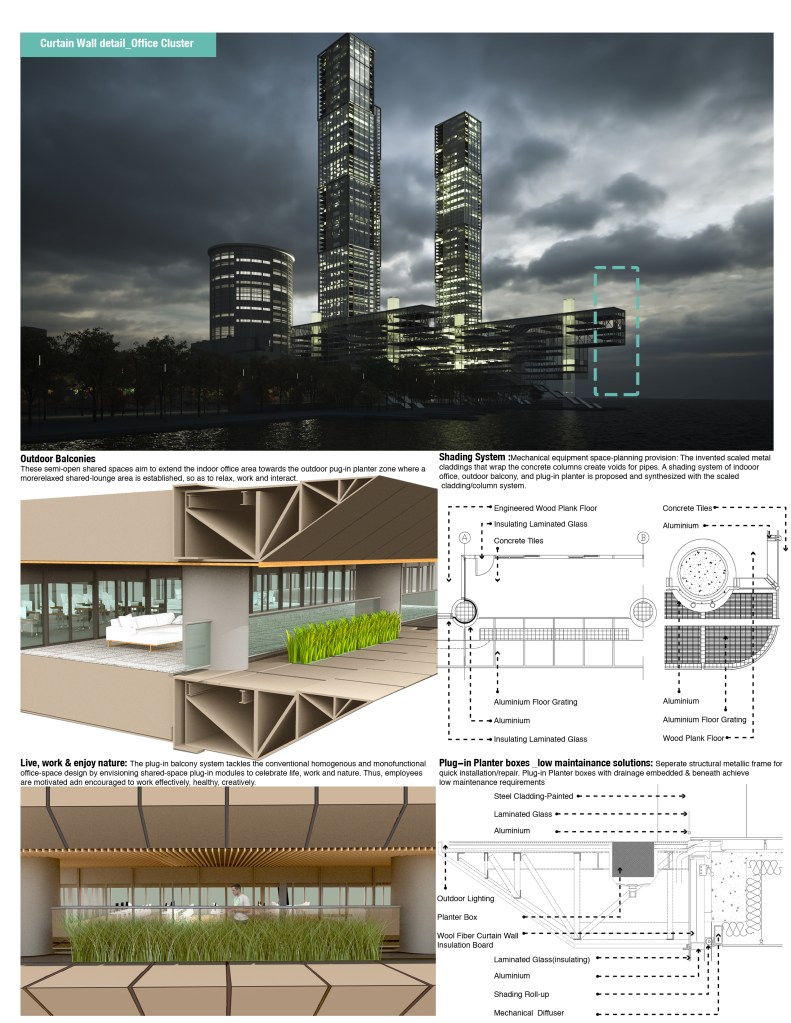
Throughout the day the façade regulates the amount of solar radiation that enters the building’s interior while offering self-shading thus mitigating the impact of the outdoor extreme climatic conditions on the interior environments. During the night, in contrast, the building transforms into a light landmark for the city.

The indoor courtyards (double and triple-height) offer opportunities for formal and ad hoc encounters promoting a more integrated and collaborative working experience for the users of the building.

#high-performance environmental design
#solar control
#thermal comfort
#energy-efficiency design
#sustainable design
#architecture & engineering synergies
#interdisciplinary collaboration
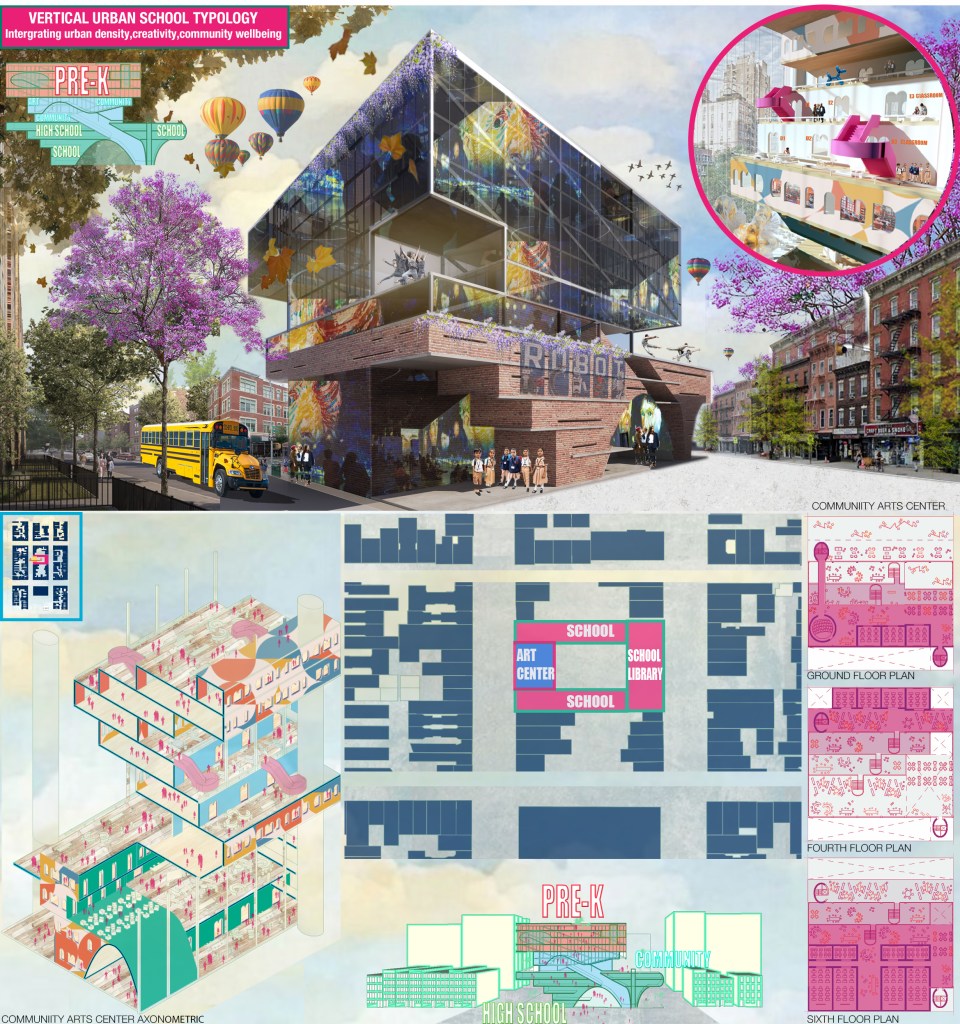


Learning Stack: Integrating density, flexibility and efficiency for community building and wellbeing

This is an addition (High School & Community Art’s Center) to an existing P.S. Elementary School in Manhattan that envisions a vertically stacked campus thus sustaining a more dense footprint while tackling the prevalent issues of the traditional vertical urban school typology ( limited walkability, minimum outdoor space, inactive dead end, and in-between void space). The addition extends the existing four-story H-shape elementary school vertically, creating a compact –cube shape that is then perforated by semi-public void elements that host blended curriculum and extra-curriculum programmatic possibilities, a new set of surfaces to apply materials and allow openings that enrich the user’s experience and creativity. Three separate entrances and meeting spaces gather the users and orient them to the three major programs. Ground floor interior atriums and rotating staircases direct the students to the high school classes and amenities while spacious elevators lead students to the pre-k’s upper floor classrooms and activity spaces. The Community Art’s center is accessed independently from the interior courtyard and connects with the two schools through shared-program terraces.
Corrugated metal and glass are the main materials used to match the existing school’s brick essence.

Vathi Library & Civic Hub

The proposal aims to construct human experience with a Spirit of Place activating an urban underutilised space that now acts as a left-over void in-between the exisitng built urban blocks and the transportation infrastructure.The aim of this multifunctional infrastructure(library & community hub) is to enable bottom-up correlations of this culturally diverse neighborhood with the traditionally recognized forms of the top-down(institutional) knowledge sharing.The library is organised around two typologies of spaces:the central atrium(a flexible space where the users of the library can “customize” the space according to their needs and re-arrange their stations in a flexible & open-ended way) and the perimeter(an authored scheme that wraps around the central atrium space where the informal story-telling is produced, archived and accessed).The remaining elements that insert within this perimeter, provide gathering spaces for workshops, community discussions or recordings production and consumption(watching videos from the archived library section, for instance). These inserts, by pushing into the outer skin of the building, also variate space in proximity to the public sidewalk and create different conditions within the interior-in-between perimeter scheme and the central atrium space.

NYC Urbanism


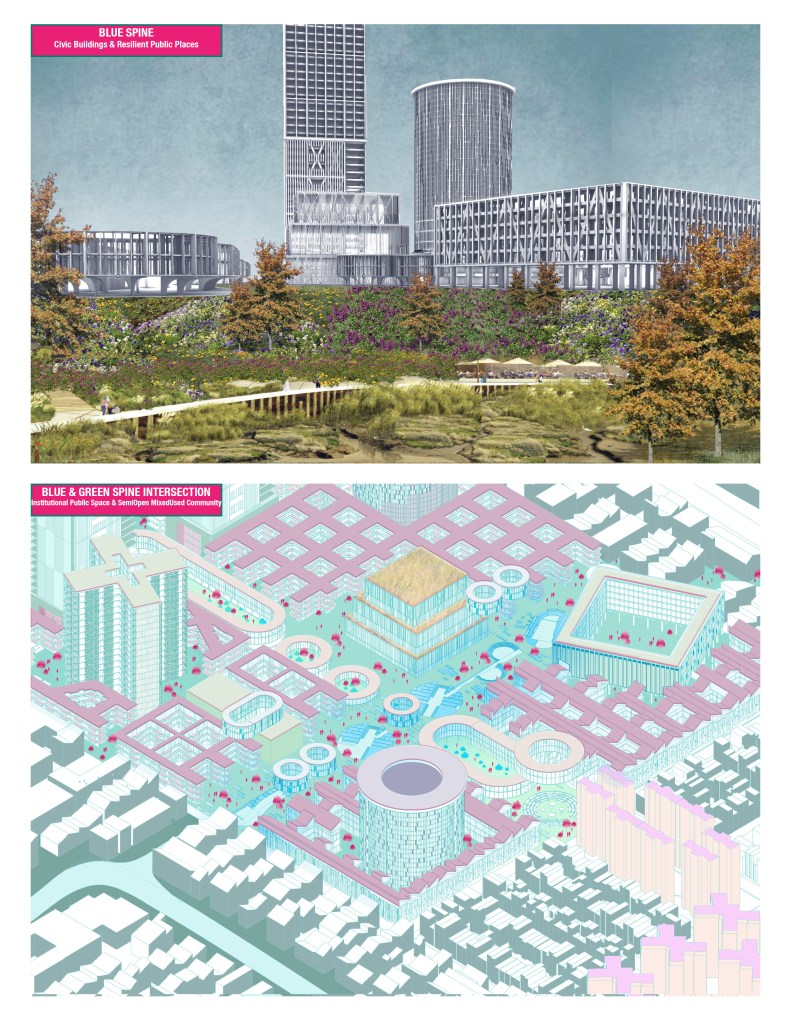
Reconciling the typical Manhattan Grid & the Tower in Park typology: New socio-spatial and programmatic possibilities for a living community at NYC’s former industrial edge.

The proposal envisions a new collective urban housing typology in order to reconstruct NYC on both programmatic and social level, which more adequately synthesizes the scales and the lifestyles between the two dominant urbanism typologies: the typical Manhattan grid and the Towers in Park typology.
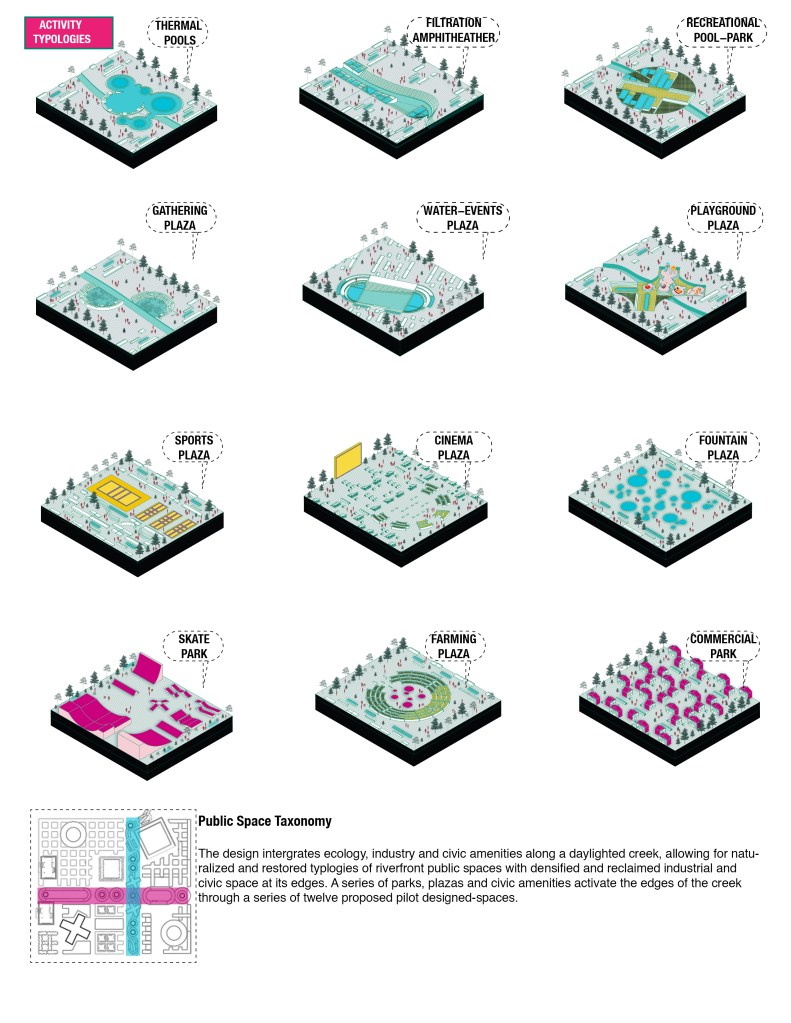
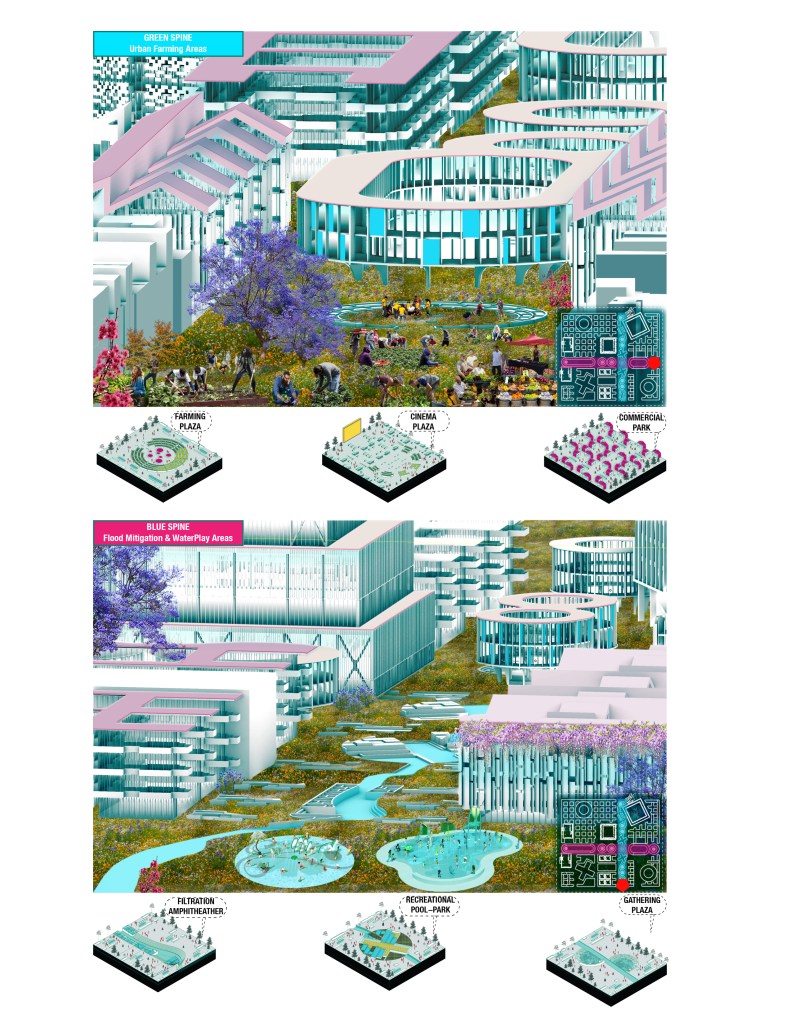
The proposal consists of three systems weaved together: the rescaled courtyard block that explores the synthesis between infrastructures and basic housing typologies, the public artifacts that provide civic amenities and multiple housing options and the connective landscape in-between that weaves the two former systems together as well as with the city nearby.
The new spatial arrangements accommodate varied domesticity options for multi-family while the new programmatic amenities and the connective landscapes set the base for a new vibrant, healthy and inclusive place at the city’s edge.
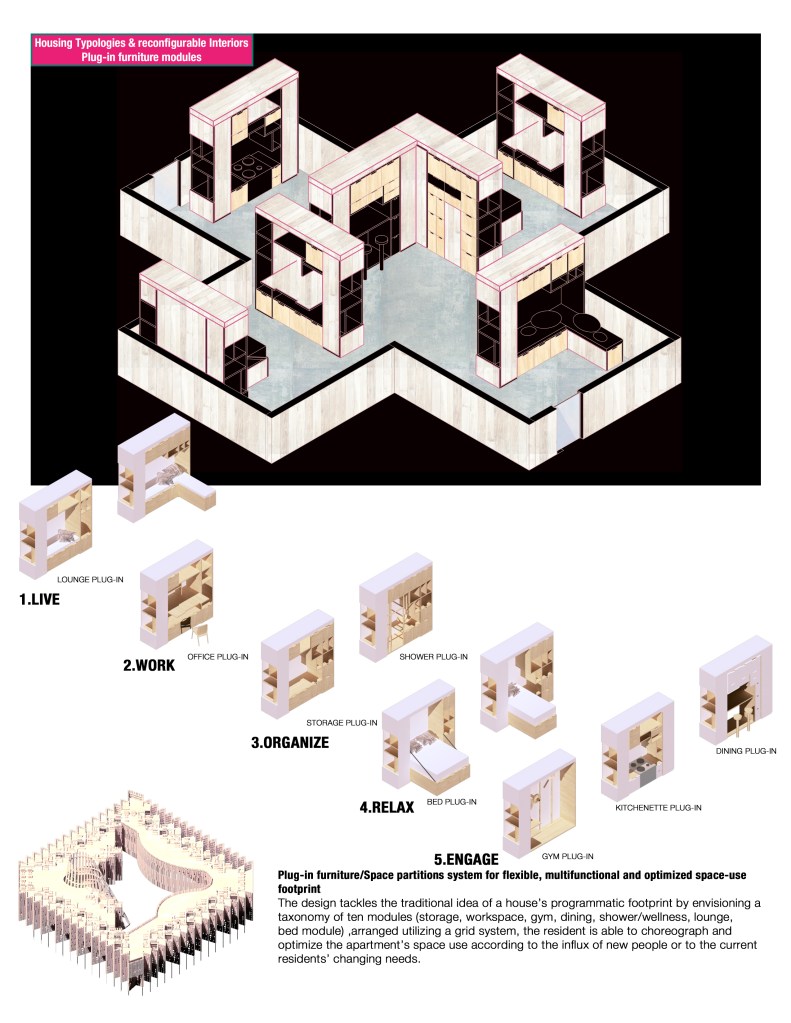
Live, work & enjoy nature: The plug-in balcony system tackles the conventional homogenous and monofunctional office-space design by envisioning shared-space plug-in modules to celebrate life, work, and nature. Thus, employees are motivated and encouraged to work effectively, healthy, creatively.

Profile

Eleni Stefania is a New York-based architect-engineer and urban designer (AIA Associate, LEED Green Associate, ENVSP) focused on designing and building more efficient, intelligent, sustainable buildings and cities.
She graduated from Columbia University Graduate School of Architecture, Planning, and Preservation (GSAPP) with a Master of Science in Architecture and Urban Design (Class 2020) after having previously completed a five-year degree in Architectural Engineering from the National Technical University of Athens (NTUA), Greece. Her work is driven by a people-first approach, tailored to the diverse social, cultural, and economic urban contexts, environmentally responsible, and flexible to adapt to long-term future growth. She has served as a reviewer and contributor for several academic magazines and professional architectural and planning conferences, such as the Urban Economy Forum’s (UEF 5) & ISOCARP’s (WPC59) World Planning Congress 2023, Columbia GSAPP”s “Managed Retreat 2023”, USGBC’s Greenbuild 2023 International Conference and Expo, and UIA World Congress of Architects Copenhagen 2023, peer-reviewing publications on building technology and climate adaptation for Professor Billie Faircloth & Maibritt Pedersen Zari scientific panel.
Eleni Kalapoda is an interdisciplinary designer on civic, cultural, institutional, and infrastructural projects that integrate systems of economies and ecologies that reimagine the flows of people and resources throughout our cities and buildings, sustaining a holistic and future-responsive strategic framework for resilient urban development that is more equitable, just, livable, and committed to restoring the balance between the Earth’s resources, ecosystems, and the communities that thrive in them.
Top Skills: #architecture #urbandesign #revit #sustainability